
Deepwater Drilling Goes Deeper: What Unprecedented Challenges Are Bearings Facing Beneath the Ocean?
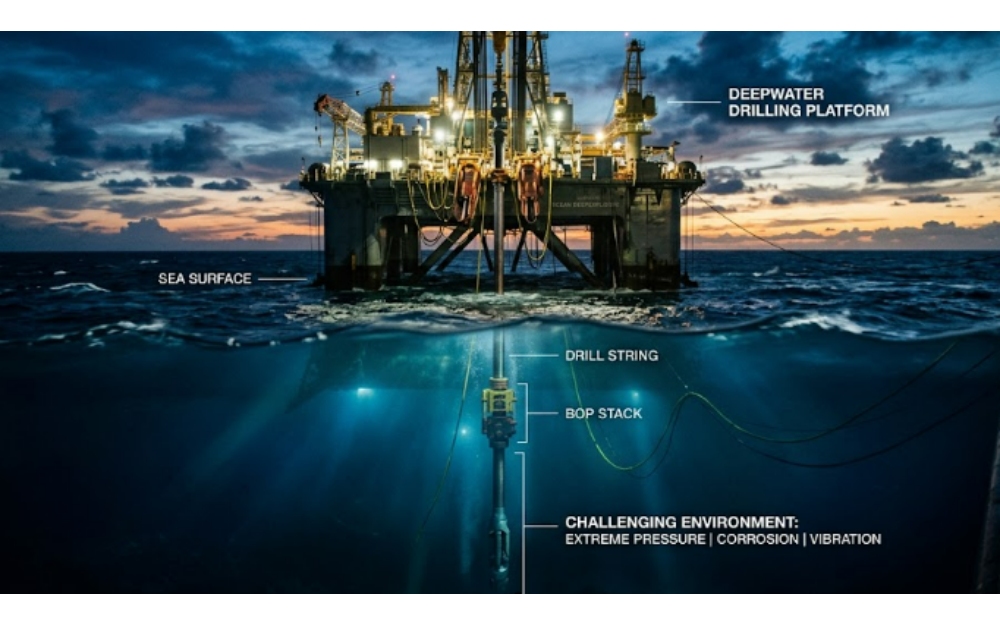
When people think about offshore oil and gas exploration, they often picture giant platforms, massive drillships, and engineers working against towering waves.
Very few people think about bearings.
Yet thousands of meters below the ocean surface, hidden inside pumps, winches, top drives, mud motors, compressors, and countless rotating systems, bearings quietly carry enormous loads every second.
As offshore drilling pushes into deeper waters than ever before, these small components are entering environments that would seem more appropriate for a science fiction movie than industrial equipment.
The question is no longer whether a bearing can rotate.
The question is whether it can survive.
The Race Toward the Ocean's Darkest Frontiers
For decades, most offshore oil production occurred in relatively shallow waters.
Today, things are changing rapidly.
Energy companies are moving farther offshore and drilling deeper beneath the seabed. New projects in regions such as the Gulf of Mexico, offshore Brazil, West Africa, and the Eastern Mediterranean are reaching water depths exceeding 3,000 meters.
To put that into perspective:
- The Eiffel Tower is 330 meters tall.
- A 3,000-meter water depth equals nearly nine Eiffel Towers stacked on top of each other.
- At these depths, sunlight disappears completely.
- Water pressure becomes crushingly intense.
For drilling equipment, every additional meter means harsher operating conditions.
For bearings, it means entering a world they were never originally designed for.
Challenge #1: Pressure That Can Crush Steel
Most people understand that water pressure increases with depth.
What many do not realize is just how dramatic the increase becomes.
At 3,000 meters below sea level, pressure can exceed 300 times atmospheric pressure.
Imagine placing a fully loaded truck on every square inch of a bearing housing.
That is the kind of force engineers must account for.
Under such extreme pressure:
- Lubricants behave differently
- Seals deform
- Internal clearances change
- Fatigue mechanisms accelerate
A bearing that performs perfectly in a factory may fail unexpectedly deep underwater.
Engineers must carefully redesign bearing geometries, materials, and lubrication systems to maintain reliable operation.
In deepwater applications, "good enough" simply isn't good enough.
Challenge #2: Saltwater Never Sleeps
If pressure is the first enemy, corrosion is the second.
And corrosion is relentless.
Unlike mechanical overloads that occur occasionally, corrosion works 24 hours a day, seven days a week.
Ocean water contains:
- Chlorides
- Dissolved oxygen
- Microorganisms
- Various minerals
Together, they create one of the most aggressive industrial environments on Earth.
A tiny imperfection in a bearing surface can become the starting point for corrosion damage.
Once corrosion begins:
- Surface roughness increases
- Friction rises
- Heat generation accelerates
- Fatigue life decreases dramatically
The challenge becomes even greater because many offshore systems are expected to operate continuously for years before maintenance opportunities become available.
A maintenance technician cannot simply drive to a deepwater drilling platform and replace a bearing whenever convenient.
Every intervention costs time and money.
Challenge #3: Bearings Must Work Longer Than Ever
In many traditional industrial environments, equipment can be inspected regularly.
Deepwater operations are different.
Every maintenance trip involves:
- Specialized vessels
- Offshore crews
- Safety planning
- Production interruptions
The cost can easily reach hundreds of thousands—or even millions—of dollars.
As a result, operators increasingly demand bearings that can survive for years without replacement.
This creates a major engineering challenge.
The bearing is no longer just a mechanical component.
It becomes a strategic asset.
Manufacturers now focus on:
- Extended fatigue life
- Superior sealing technologies
- Advanced lubrication retention
- Predictive maintenance compatibility
The objective is simple:
Install it once and forget about it.
Achieving that goal, however, is far from simple.
Challenge #4: Bigger Equipment Means Bigger Loads
Modern offshore projects are becoming larger and more powerful.
Drilling rigs use heavier equipment.
Pumps move greater volumes.
Winches handle larger subsea structures.
Everything is scaling upward.
As equipment grows, bearings must handle:
- Higher radial loads
- Greater axial forces
- Increased vibration
- Stronger shock loads
The challenge resembles asking a marathon runner not only to run farther but also to carry a heavier backpack.
Eventually, traditional designs reach their limits.
This is why engineers increasingly rely on:
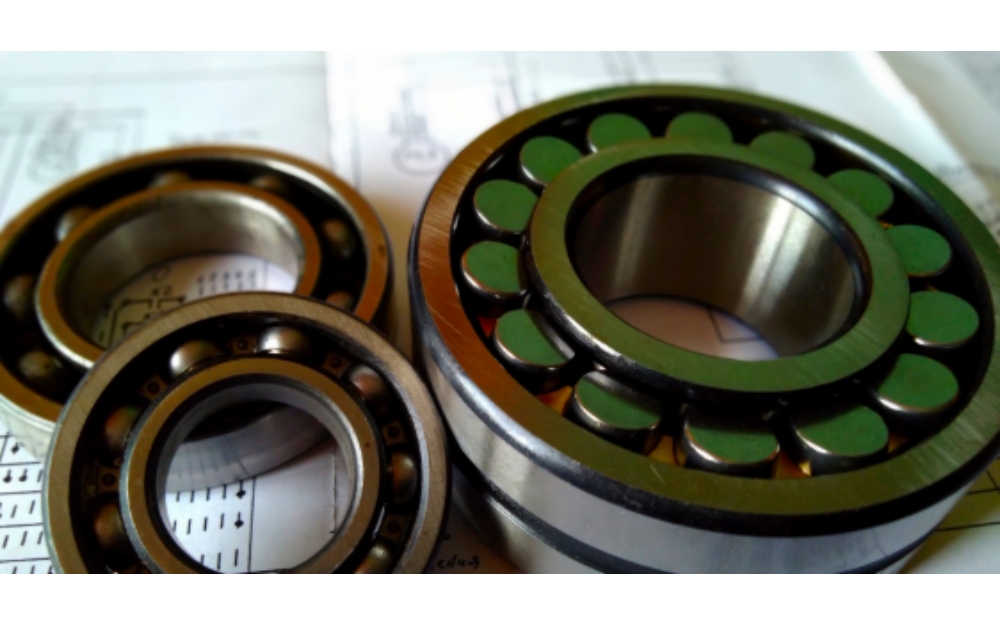
- Large spherical roller bearings
- Advanced tapered roller bearings
- Hybrid bearing technologies
- Customized bearing assemblies
The future of offshore drilling may depend as much on bearing innovation as on drilling technology itself.
Challenge #5: Heat Where You Least Expect It
Many people imagine deep oceans as freezing cold.
And they are.
But surprisingly, heat remains a major problem.
Why?
Because bearings generate their own heat.
Friction creates temperature increases inside rotating systems.
At the same time:
- Sealed housings trap heat
- High loads increase friction
- Limited cooling opportunities restrict heat dissipation
Excessive temperatures can degrade lubricants and shorten bearing life dramatically.
Engineers now spend significant effort optimizing:
- Lubricant chemistry
- Cage design
- Surface finishing
- Internal geometry
In deepwater drilling, thermal management has become just as important as mechanical strength.
Challenge #6: The Rise of Intelligent Bearings
Perhaps the most exciting development is that bearings are beginning to "talk."
Not literally, of course.
But modern bearing systems increasingly include sensors capable of monitoring:
- Temperature
- Vibration
- Speed
- Lubrication condition
- Load variations
These smart bearings provide real-time data that helps operators detect problems before failures occur.
Imagine a bearing sending an early warning months before a breakdown.
Instead of reacting to a failure, maintenance teams can plan interventions strategically.
This approach is transforming offshore maintenance.
The future is shifting from:
Fix after failure
to
Predict before failure
And in offshore drilling, prediction can save millions.
Challenge #7: Sustainability Is Changing Bearing Design
A surprising force is influencing bearing development: sustainability.
Oil and gas companies increasingly face pressure to:
- Reduce emissions
- Improve energy efficiency
- Extend equipment life
- Minimize waste
Bearings contribute more than many people realize.
Lower-friction bearings can:
- Reduce power consumption
- Improve equipment efficiency
- Lower operating temperatures
- Extend lubrication intervals
Even a small reduction in friction can produce significant savings across large offshore installations operating continuously.
As a result, bearing manufacturers are investing heavily in:
- Ceramic hybrid technologies
- Advanced coatings
- Low-friction surface treatments
- Eco-friendly lubricants
The bearing of the future must be stronger and greener at the same time.
The Next Frontier: Bearings for Autonomous Offshore Operations
The offshore industry is gradually moving toward automation.
Future platforms may require fewer workers onboard.
Remote monitoring centers may oversee equipment from thousands of kilometers away.
Subsea production systems are becoming increasingly autonomous.
This trend creates an entirely new requirement.
Bearings must become:
- More reliable
- More intelligent
- More self-monitoring
- More maintenance-free
In other words, future bearings will need to behave less like passive components and more like active participants in equipment health management.
The humble bearing is evolving into a sophisticated engineering system.
Conclusion: Small Components, Giant Responsibilities
When people discuss deepwater drilling, conversations usually focus on reservoirs, drilling technologies, and billion-dollar platforms.
Yet hidden inside nearly every rotating system is a component no larger than a dinner plate.
That component often determines whether production continues—or stops.
As drilling operations venture deeper into the ocean than ever before, bearings face unprecedented challenges:
- Crushing pressure
- Aggressive corrosion
- Massive loads
- Extended service intervals
- Rising sustainability demands
- Increasing digitalization
The future of offshore energy will not be built solely by larger rigs or more powerful equipment.
It will also depend on smarter, stronger, and more resilient bearings.
Because sometimes the smallest parts carry the biggest responsibilities.
FAQ
What types of bearings are commonly used in offshore drilling equipment?
Common options include spherical roller bearings, tapered roller bearings, cylindrical roller bearings, thrust bearings, and increasingly, hybrid ceramic bearings designed for harsh environments.
Why is corrosion such a major problem for offshore bearings?
Saltwater contains chlorides and dissolved oxygen that continuously attack metal surfaces, accelerating wear, pitting, and fatigue damage.
How do smart bearings help offshore operators?
Smart bearings use embedded sensors to monitor operating conditions and provide early warnings of potential failures, enabling predictive maintenance.
Are ceramic bearings becoming popular in offshore applications?
Hybrid ceramic bearings are gaining attention because they offer lower friction, improved corrosion resistance, and longer operating life in demanding environments.
What is the biggest challenge for future offshore bearings?
The combination of deeper water, longer maintenance intervals, higher loads, and autonomous operations is pushing bearing technology to evolve faster than ever before.
 Deepwater Drilling Goes Deeper: What Unprecedented Challenges Are Bearings Facing Beneath the Ocean?
 Why Humanoid Robots Are Creating a New Bearing Boom
 “Silent” and “Low Friction”: Why Bearings in 2026 Are Quietly Changing the World
 Bearings vs. Humans: Who Handles Stress Better?